The system passed hydrotest. The certificate is signed. Two weeks later, as gas goes in for start-up, the flange downstream of the filter starts to hiss. Everyone asks the same question: we hydrotested this, so why is it leaking?
Short answer: a nitrogen helium leak test and a hydrotest answer different questions. The hydrotest asks whether the pipe and its welds are strong enough. The N2/He leak test asks whether the complete, reinstated system is gas-tight at operating pressure. Passing one tells you nothing about the other.
What does a hydrotest prove?
A hydrostatic test proves the strength and tightness of newly fabricated piping before it goes into service. Under ASME B31.3 para. 345.4.2 the minimum test pressure is 1.5 × design pressure, corrected for the ratio of allowable stress at test and design temperature. Pressure is held for at least 10 minutes (para. 345.2.2) before every joint is examined. Gas pipelines under ASME B31.8 follow location-class factors and the project spec.
Water is used because it is practically incompressible. If a pipe fails at test pressure, little energy is released; you get a puddle, not shrapnel. That is why hydrotest is the default strength test.
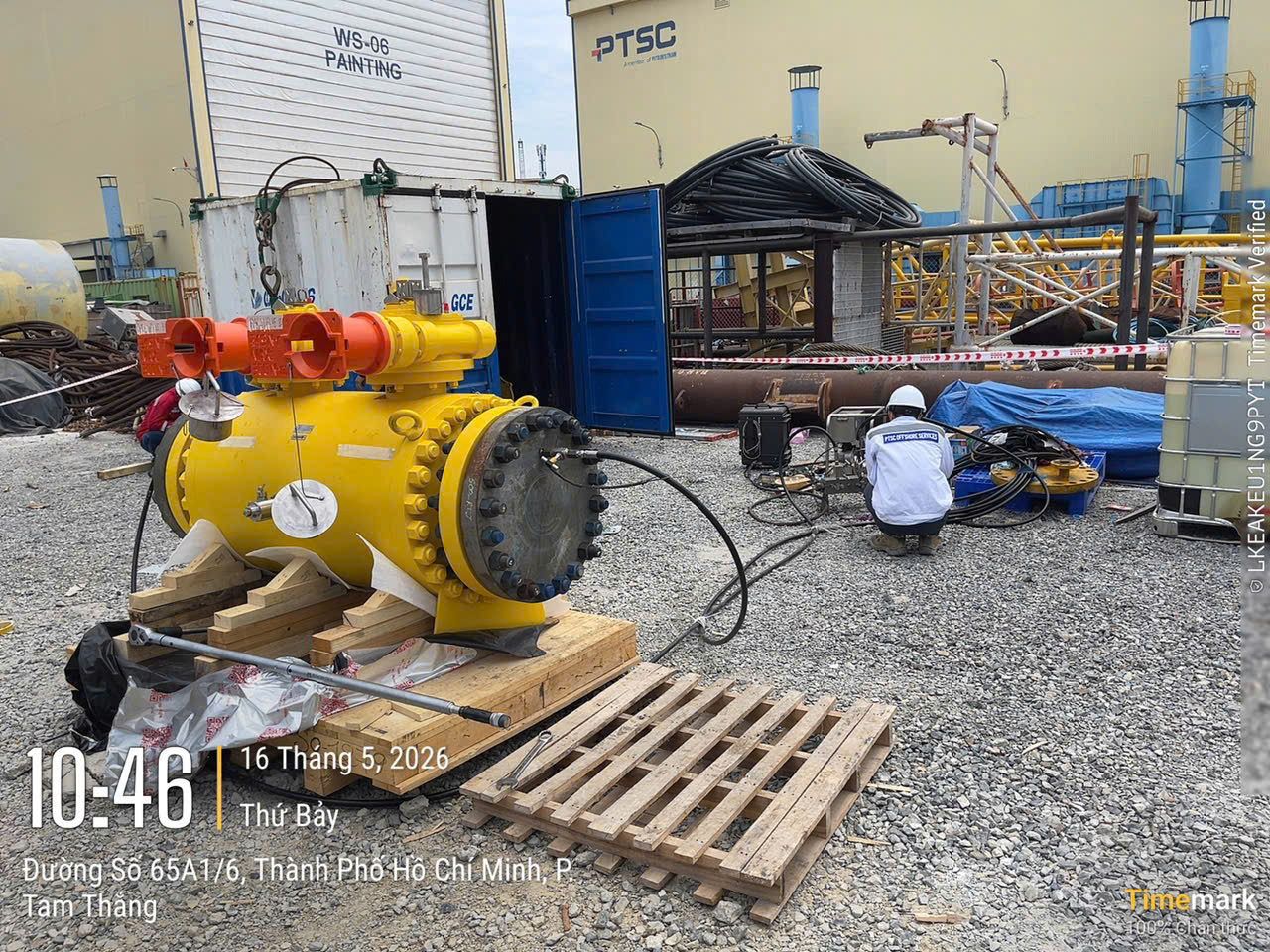
On site, though, hydrotest has three limits everyone runs into.
It is usually done before the system is complete. Control valves, instruments, PSVs and bursting discs are removed or isolated and replaced with temporary spools, blinds and spades. The joints you test are often temporary joints.
After hydrotest, flanges get broken: spades come out, valves go back in, gaskets are replaced. Every one of those is a new joint that nobody has tested.
Water leaves a legacy. In hydrocarbon gas, glycol or instrument air systems, water trapped at low points means corrosion, hydrate risk, and days of dewatering and drying.
More on our hydrostatic pressure testing service.
What does a nitrogen helium leak test prove?
The N2/He service leak test is done at the end of pre-commissioning, with the system built exactly as it will run: real valves, real instruments, final gaskets, every flange torqued to procedure. The system is filled with roughly 99% nitrogen and 1% helium and pressurised close to operating pressure. Major international providers typically test at around 90% of design or PSV set pressure to simulate operating conditions, but the final number always comes from the client’s spec.
Technicians then walk every joint with a helium sniffer. Helium molecules are tiny and almost absent from ambient air, so even a very small leak triggers the detector. Helium tracer gas detection is the most sensitive commercially used leak test method, and it pinpoints the leak, which soap solution and pressure gauges cannot.
Put simply: the hydrotest checks the pipe. The leak test checks the plant you are about to start.
A bonus that rarely gets mentioned: when the test is done, the system is dry and full of inert gas. Vent down to a slight positive pressure and it is nitrogen-blanketed and ready for hydrocarbons. Purging and leak testing in one operation.
N2/He leak test vs hydrotest at a glance
| Hydrotest | N2/He leak test | |
| Question answered | Are pipe and welds strong enough? | Is the complete system gas-tight? |
| When | After fabrication, before reinstatement | After reinstatement, before start-up |
| Medium | Water (with additives if needed) | ~99% N₂ + ~1% He |
| Test pressure | ≥ 1.5 × design (ASME B31.3, 345.4.2) | Close to operating, per project spec |
| Leak detection | Visual, pressure gauges | Helium sniffer, temperature-corrected pressure decay |
| Stored energy | Low | Very high, exclusion zone required |
| Leaves behind | Water, needs dewatering and drying | Dry, inerted system |
Why not just use gas for the strength test?
Because gas is compressible. At the same pressure and volume, the stored energy in gas is hundreds of times higher than in water. A failure during hydrotest is a wet floor. A failure during a gas test is flying metal.
ASME B31.3 para. 345.5 does allow a pneumatic test in place of hydrotest, at 1.1 × design pressure, but only where hydrotest is impracticable and with a risk assessment, safe distances and brittle-fracture checks. That is an alternative strength test under strict conditions, a different job from an N2/He leak test, and the two get mixed up in scopes of work more often than they should.
Field reality: what the paperwork doesn’t tell you
The flanges that leak are rarely the difficult ones. They are the ones broken to pull spades after hydrotest and re-torqued at five o’clock on a Friday. That is why flange management (tagging, bolt and gasket records, torque values, who torqued it) has to go hand in hand with leak testing. A flange torqued by feel will leak in fact.
Temperature distorts pressure decay. Offshore, piping in direct sun heats up through the morning, internal pressure rises with it, and a small leak hides behind the rise. Hold periods need recorded temperatures and correction, or a time window with stable conditions.
Gauges and detectors must be in calibration, and the helium detector checked against a calibrated leak before each shift. Nitrogen doesn’t lie. An uncalibrated gauge might.
Nitrogen is not toxic, but it asphyxiates. Venting near tank entries, enclosed modules or equipment rooms is a real hazard. Route vents to open areas and monitor O₂ where needed.
What does a safe N2/He leak test procedure look like?
The core steps: define the test pack boundary on the P&ID and mark the isolation points; complete flange management and a system walkdown; issue the PTW and set up barriers and the exclusion zone; pressurise in stages, holding at each stage for checks before going higher; sniff every joint at test pressure; hold and record temperature-corrected pressure decay; vent down in a controlled way to slight positive pressure and hand the system over inerted.
Every pressure stage is a hold point. If a leak is found, depressurise before re-torquing. Never tighten a flange under pressure.
How HT Energy runs N2/He leak tests
HT Energy runs N2/He leak tests with liquid-nitrogen converter pumps delivering up to 180,000 SCF/h at test pressures up to 15,000 psi, blending 99% N₂ / 1% He on site. Our pressure testing systems work up to 20,000 psi for functional and other pressure tests. Every test pack is prepared in full, from marked-up P&IDs and joint lists to test certificates and pressure charts, under an ISO 9001:2015 quality system certified by BSI.
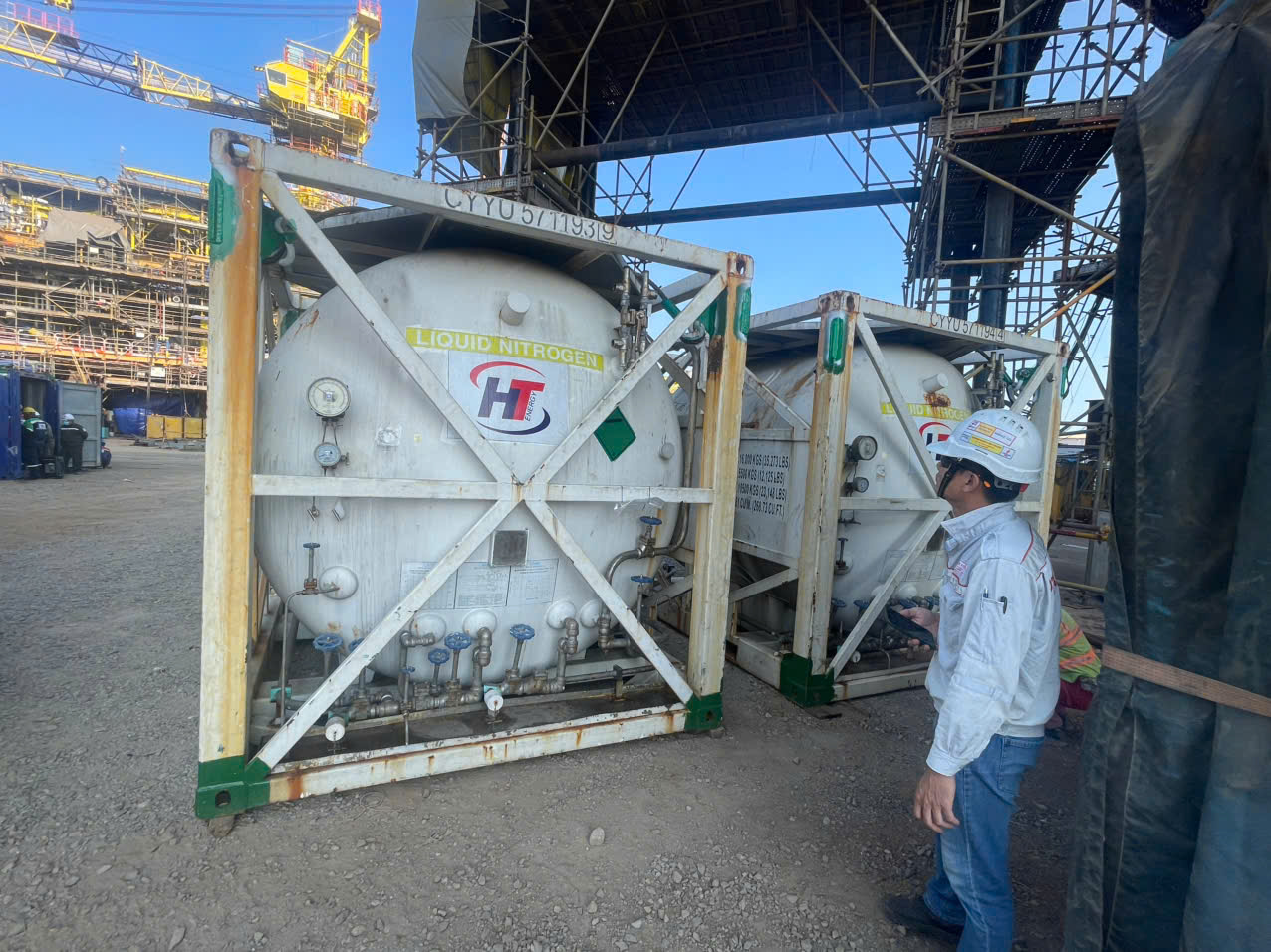
N2/He leak testing usually runs alongside flange management and hot oil flushing during pre-commissioning. See our N₂-He leak testing & nitrogen purging services.
FAQ
Q: Do we still need an N2/He leak test after a successful hydrotest? Yes, for gas and hydrocarbon systems. Hydrotest happens before valves and instruments are reinstated and spades removed. Joints broken after that are only proven by a leak test on the complete system.
A: What pressure is used for an N2/He leak test? Usually close to operating pressure; many projects use around 90% of design or PSV set pressure. The exact value comes from the client spec and must not exceed the design pressure of the weakest component in the test pack.
Q: Why only 1% helium? 1% helium is enough for the detector to find very small leaks, at a fraction of the cost of pure helium. Nitrogen carries the tracer and inerts the system.
A: Is nitrogen leak testing dangerous? It can be. The main hazards are the stored energy of compressed gas and asphyxiation. They are controlled with PTW, exclusion zones, staged pressurisation, venting to open areas and O₂ monitoring.
Q: Is a pneumatic test the same as an N2/He leak test? No. A pneumatic test under ASME B31.3 para. 345.5 is an alternative strength test at 1.1 × design pressure, under strict conditions. An N2/He leak test checks the tightness of the complete system close to operating pressure.
A: Planning a leak test for your next test pack, or want our engineers to review the scope first? Call +84 903 332 711, email info@htenergies.com, or use our contact page.
References
-
- ASME B31.3 Process Piping, 2022 edition: summary of changes, ANSI
- Baker Hughes, N2/He leak detection service datasheet
- Pfeiffer Vacuum, Tracer gas leak detection with helium and hydrogen